Uav Aluminum Cnc Machining Parts support many critical drone functions, from structural frames to precision payload mounts. Their value is not limited to low weight. Properly machined aluminum can provide stiffness, thermal conductivity, corrosion resistance, and repeatable dimensional accuracy. These qualities matter when a drone carries a camera, mapping sensor, communication module, or compact delivery mechanism.
W. Edwards Deming, a widely respected manufacturing quality expert, said, “Quality comes not from inspection, but from the improvement of the production process.” That principle fits Uav Aluminum Cnc Machining Parts closely. A motor bracket may look simple, yet its bolt spacing, flatness, and vibration resistance can affect flight stability. A small error matters. Sometimes, too much confidence causes trouble.
Common applications include UAV arms, landing-gear supports, battery housings, electronic enclosures, propeller hubs, heat sinks, and camera gimbal components. CNC machining allows manufacturers to create precise pockets, threaded holes, thin walls, and complex mounting surfaces. Materials such as 6061-T6 aluminum suit many general-purpose drone parts, while 7075-T6 offers higher strength for demanding assemblies. Surface treatments, including anodizing, may improve wear resistance and appearance.
However, design decisions require balance. Removing too much material can reduce weight but weaken the part. Tight tolerances can improve alignment but increase production cost. Engineers should consider loads, vibration, heat, corrosion, machining access, and inspection requirements before production. A reliable supplier should provide material certification, dimensional reports, and traceable process records. The best result is not merely a lighter component. It is a dependable part that performs consistently in real operating conditions.
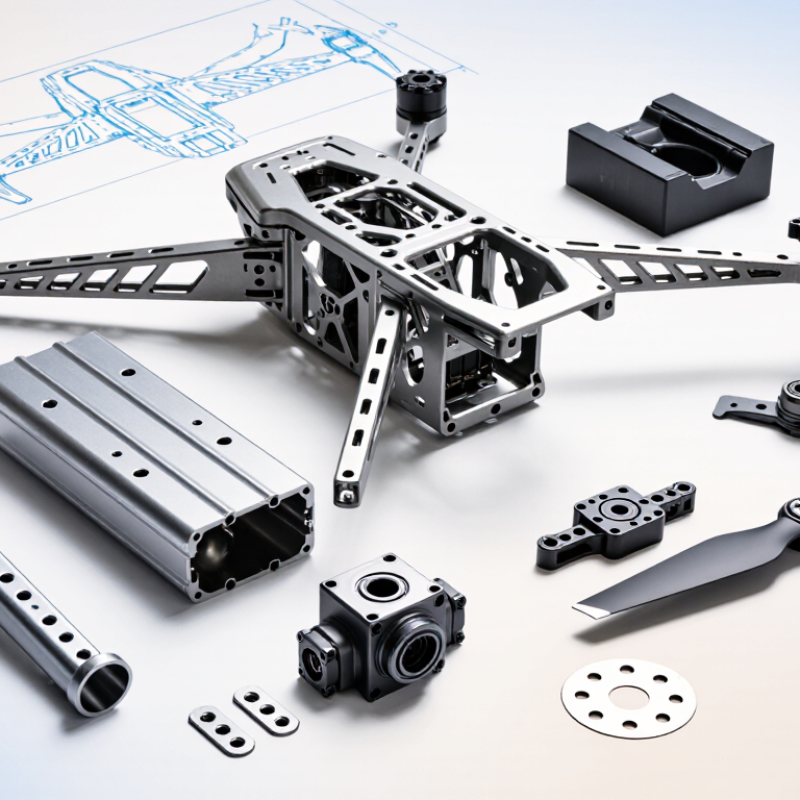
UAV aluminum CNC machining parts are precision components made from aluminum billets using computer-controlled cutting tools. The process removes material to create accurate shapes, holes, threads, and mounting surfaces. These parts may include motor mounts, frame plates, landing brackets, sensor housings, and camera supports. Aluminum offers a useful balance of low weight, strength, corrosion resistance, and heat dissipation.
They help connect the aircraft’s major systems. A motor mount must hold alignment during vibration and sudden acceleration. A sensor housing needs stable dimensions and protection from dust or impact. Frame plates distribute loads around battery compartments and electronic modules. In practical production, engineers often choose alloys according to strength, machinability, and operating temperature. A thinner wall saves weight, but it may reduce stiffness.
Small details matter.
CNC machining also supports repeatable production. Engineers can inspect critical dimensions with coordinate measuring equipment, calipers, and thread gauges. Surface finishing may improve appearance and reduce oxidation, but it cannot repair a poor design. I have found that tight tolerances are not always better; they can increase cost without improving flight performance. Tool marks, sharp edges, and weak corners still require attention. Design reviews should consider vibration, fastener loads, drainage, and access for maintenance. Even a well-machined aluminum part can fail when its actual operating conditions are underestimated.
They are precision components cut from aluminum billets using computer-controlled tools. Common examples include motor mounts, frame plates, and sensor housings.
Motor mounts, arm joints, landing brackets, battery frames, camera supports, and protective housings are common choices. Each part has a different load.
Aluminum combines low weight, strength, corrosion resistance, and heat dissipation. This balance supports efficient flight and compact designs.
Accurate holes and mating surfaces reduce looseness, vibration, and assembly errors. Lower mass may improve handling and flight endurance.
CNC tools create repeatable dimensions, threads, holes, and mounting surfaces. Inspectors may use calipers, thread gauges, and coordinate measuring equipment.
No. A thin wall may save weight but reduce stiffness. A very light part can flex during vibration or sudden acceleration.
They should check dimensions, threads, surface condition, sharp edges, and final fit. Vibration testing can reveal problems missed during measurement.
No. Finishing can improve appearance and reduce oxidation. It cannot repair poor geometry, weak corners, or underestimated operating loads.
Drainage, maintenance access, fastener loads, thermal expansion, and vibration deserve attention. Small details matter.
Not always. Material choice depends on strength, machinability, temperature, stiffness, and actual flight conditions. Some designs need refinement after testing.
Uav Aluminum Cnc Machining Parts are precision-engineered components made from aluminum alloys for unmanned aerial vehicles. They are produced through computer-controlled milling, turning, drilling, and finishing processes, allowing manufacturers to create accurate shapes, tight tolerances, and reliable mounting interfaces. Depending on the design, these parts may support the airframe, motors, landing gear, camera systems, battery compartments, control modules, and other essential UAV assemblies.
Their lightweight structure helps reduce overall aircraft weight while maintaining the strength needed for regular flight operations. Aluminum also offers good corrosion resistance, heat dissipation, and dimensional stability, which can improve UAV efficiency, durability, and service reliability. When selecting CNC aluminum parts, users should consider the UAV’s size, payload, operating environment, vibration levels, required tolerances, surface treatment, and production volume. Choosing the right material grade, machining method, and inspection standard ensures that each component matches its specific application and contributes to safe, stable, and consistent performance.

 Creatingtec